



If you were ever handed a target like “fill 200 warehouse associate positions by November”, you’ll know that the best high-volume recruiting strategies differ from traditional hiring. Not entirely – you’ll likely recognise most of these tactics – but just enough to feel the distinction.
What changes things is that everything is amplified at a volume. With traditional hiring, most of these tension points would go unnoticed, but when every small bit of friction is multiplied across hundreds of openings and thousands of applicants, the impact becomes clear.
This is where the need for high-volume recruitment strategies comes into play. They focus less on doing more, and more on removing friction at every stage, from the first job ad views to the end of a new hire’s first 90 days.
If you’re new to high-volume recruiting, you can start with our complete guide to high-volume recruiting. If you’re already hiring at scale and wondering, “What does a high-volume hiring strategy actually mean?”, you’re in the right place.
In this article, we’ll walk you through 12 high-volume recruitment strategies, grouped by the stage of the hiring funnel they improve. We’ll cover:
- What makes a high-volume recruiting strategy different?
- Attract: High-volume recruiting strategies to bring in the right applicants
- Apply: Strategies to stop candidate drop-off at scale
- Screen: Strategies to shortlist hundreds of applicants fast
- Hire: Strategies to close many candidates before competitors do
- Retain: High-volume recruiting strategies to make hires stick
- Where to start: Prioritising your high-volume hiring strategy
- High-volume recruitment strategies FAQs
What Makes a High-Volume Recruiting Strategy Different?
Most of the tactics we detail below aren’t completely new. You’ll recognise plenty of them from everyday hiring. What changes is the volume at which these apply, which in turn impacts the maths in terms of both operations and consequences. That is, seemingly small inefficiencies in your funnel are multiplied by the number of roles you’re filling, resulting in accumulating leaks that are typically only observed too late.
For example, making candidates create an account first might only add two minutes to one application. But across 200 openings and 20,000 applicants, those two minutes can create friction, with hundreds of people never finishing applying.
So how do you stay ahead of losses you can’t see until it’s too late? You anticipate them and build them into the hiring plan from the start – which often means working backwards instead of forwards like in traditional recruiting.
In practice, that means deciding how many people you need, where, and by which start date, before you post a single job ad. Then use your past campaigns to work out how many applicants it takes to make one hire, and account for the likelihood of losing people along the way. This can mean candidates dropping out, failing background checks, or simply refusing to show up for their first day.
Start with the end in mind. Work backwards from the number that you need to be in the seat on day one, and then decide how many candidates and applicants you need through the process.
Working backwards from the deadline and goal, while keeping the funnel in mind, tells you what needs to be addressed first. Using a mix of the 12 strategies below, all grouped according to funnel stage, you’ll be able to hit that number while keeping quality at the forefront.
Attract: High-Volume Recruiting Strategies to Bring In the Right Applicants
While high-volume hiring runs on numbers, just hitting those numbers isn’t enough. Thousands of applicants mean zilch if most of them are a fit or are too expensive to reach. These six strategies help you bring in the right people, at a cost that’s sustainable for you:
- Lead with an EVP frontline candidates care about
- Let performance data choose your job titles and locations
- Distribute your job ads across multiple diverse channels
- Dynamically move budgets to the channels that convert
- Rediscover past applicants before sourcing new ones
- Turn current employees into recruiters with referrals
1. Lead With an EVP Frontline Candidates Care About
Essentially your employee value proposition (EVP) answers one candidate burning question: “why should I work here rather than down the road?”
For corporate roles, that answer is often about career growth and culture. For high-volume roles, it’s usually far more practical, like beneficial hourly pay, shift patterns, travel time, and start times. Without putting these details front and centre from the start, candidates may miss the best parts of working with you, and apply somewhere that made them easier to find.
How to do it
- Put the deal in the first lines of the job ad: hourly pay or salary range, shift pattern, location, and start date.
- Answer the questions candidates actually ask: weekly pay, overtime, parking or transport links, uniforms, and whether experience is needed.
- Show the job as it is: a short video or photo from the shop floor or warehouse is more immersive than a stock image of a smiling team.
- Write for the people you actually hire: most high-volume roles attract the same handful of candidate types time and time again, like students or semi-retired people looking for something to do. Write a version of your job ad for each one, so a student sees evening shifts that work around lectures and a parent sees shifts that fit around the school run.
2. Let Performance Data Choose Your Job Titles and Locations
Job titles are a seemingly small detail in a job ad, but one of the most underrated levers in high-volume hiring. Candidates search for the job they know (“warehouse operative”, “delivery driver”), not creative internal titles (“fulfilment associate II”). While an alternative may feel more on-brand, nobody finds it if nobody searches for it.
Same goes for location. A job ad targeted at the city centre can miss out on towns where your best-fit candidates actually live.
How to do it
- Use the search terms candidates use: check job board search data or your own historical applications for the titles that pull in the most applicants.
- A/B test one variable at a time: play around with the title first, then the first lines of the description, then location radius.
- Widen geo-targeting deliberately: Check how far people are actually willing to travel, not just how far away they live. For example, ASICS found that candidates in Canberra wouldn’t commute more than 15 minutes, so the team shifted its advertising to a nearby area where a 30-minute journey was perfectly normal.
3. Distribute Job Ads Across Multiple Diverse Channels
Relying on one or two job boards may work for a while, but at scale it’s bound to fall short. When every employer in your area is fishing in the same pond, CPC climbs and the applicant pool shrinks.
A multichannel approach puts each job ad on the mix of general job boards (e.g., Indeed), niche boards, aggregators, and search channels where that specific role performs best. Think of a forklift driver and a care assistant: they rarely look for work in the same places, so they shouldn’t share the same channel mix.
How to do it
- Map channels by role and location: Don’t rely on habit or resort to whichever contract is up for renewal.
- Include niche and local boards: Doing so can help target hard-to-fill roles such as drivers, nurses, or multilingual call centre agents.
- Reach passive candidates with social media: Instagram, Facebook and TikTok reach younger, best-fit candidates that may not be browsing job boards at all.
- Post once, distribute everywhere: Copying the same job ad into ten job board dashboards by hand doesn’t scale. With Hirematic, you create a job ad once and reach hundreds of best-fit job boards, including the contracts you already have, like your Indeed account.
- Go local where jobs fall short: For new sites and hard-to-fill locations, offline avenues can work. Think chambers of commerce, community groups, partnerships with nearby businesses, and a “now hiring” sign with a QR code on a store that’s about to open.
4. Dynamically Move Budget to the Channels That Convert
Distribution gets eyes on your job, but budget allocation decides whether that visibility results in hires at a sensible cost. The problem is that most hiring budgets are locked into annual job board contracts and reviewed once a quarter, if at all, which often results in waste. Aptitude Research found that up to 40% of job advertising budgets is wasted on inefficient deals and infrequent optimisation.
The fix is to let performance guide your budget. When one job board starts delivering cheaper applicants for a role, more of your spend goes there. When another doesn’t, you pull back in real-time, without waiting for a contract renewal or a quarterly review.
How to do it
- Review performance frequently, not quarterly: channel performance shifts with seasonality and competitor activity. An AI-assisted tool like Hirematic can help you reallocate budget across channels based on live performance. See how it works.
- Measure what matters: compare channels on cost per application and cost per hire, not clicks or impressions.
- Stop when you have enough: cap how many applications each role collects with features such as Hirematic’s CV Limits, so campaigns pause once you have a pool your team can actually review.
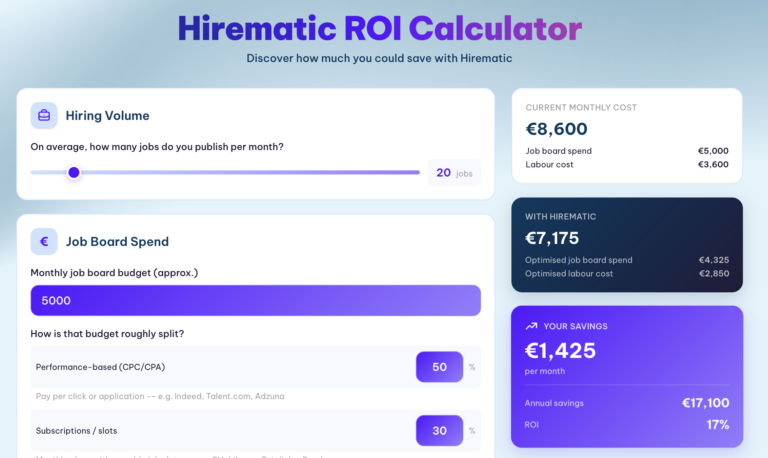
Calculate the cost of your recruitment advertising efforts
5. Rediscover Past Applicants Before Sourcing New Ones
Your cheapest applicants are the ones you’ve already paid for. Last season’s runner ups, candidates who withdrew for timing reasons, and former seasonal staff who left on good terms already know your brand, and many have already passed screening – which means they’re cheaper to hire.
How to do it
- Search your ATS before every campaign for past applicants who reached interview or offer for the same role and location.
- Only contact people who consented to hear about future roles, and keep that consent record up to date.
- Send a short, personal message with the role, pay and start date, and a one-tap way to say yes.
- Keep an always-on pool for repeat roles: Leave an evergreen “register your interest” ad open, keep the pool warm with an update every few weeks (new sites, new projects, team news), and search it for a couple of days before you post a new job ad.
6. Turn Your Employees Into Recruiters With Referrals
Your current frontline staff know exactly who in their network would be good at the job, and can help you reach your high-volume goals quicker. Referred candidates also arrive with a realistic picture of the role, which tends to help retention.
How to do it
- Make referrals take seconds: a QR code in the break room or a shareable link in the staff app makes referrals quicker than a form on the intranet.
- Pay the bonus in stages, for example half on start date and half after 90 days, to reward referrals that stick.
- Open referrals to former employees: alumni who left on good terms already know the job and the culture, and often know people who’d fit right in.
Apply: Strategies to Stop Candidate Drop-Off At Scale
Getting candidates to click your job ad is only half the battle. The application form is where friction shows up – and what either turns a click into an applicant or a lost candidate. At volume, this is often where the biggest losses happen. They’re also usually the hardest to spot, because candidates who quit halfway through don’t show up in your reports. Being proactive with a strategy like the one below can stop potential candidates from slipping away.
7. Make it quick and easy to apply on a phone
High-volume candidates apply on the go: on a break, on the bus, or between shifts. The issue? Most application forms are still built for a desk and an uninterrupted afternoon. If your application needs them to create an account, upload a CV from a desktop, and retype their work history, many won’t finish. In fact, iCIMS found that 60% of frontline workers have started an application and left it unfinished, with half of them citing a form that was too long.
How to do it
- Test your own form on a phone: Start From the top to the very end, and time it. Aim for under five minutes, ideally two.
- Cut every field you don’t need to make a first decision: work history and references can come later.
- Make the CV optional: For roles such as warehouse or retail rules where the CV doesn’t predict performance, consider making the CV field optional.
- Don’t add heavy steps early on: Asking for a recorded video interview straight after someone applies can wipe out a big share of your pool. Jemena saw about a third of its graduate applicants drop out at that step, and removed it.
- Let candidates apply quickly: instead of redirecting them to a careers site, enable them to apply where they found the job ad. Hirematic’s 1-Click-Apply, for example, sends candidates to a short, brandable job page and delivers up to 4x higher conversion than sending them to an external website.
Screen: Strategies to Shortlist Hundreds of Applicants Fast
More applications are only good news if your team can get through them efficiently. At volume, this stage can turn into a bottleneck, with recruiters buried in CVs and candidates left waiting – or worse, ending up hired by someone faster. Here are a few ways to speed up that process:
- Ask knockout questions up front
- Contact candidates within hours, not days
8. Ask Knockout Questions Up Front
Knockout questions (aka deal-breaker or must-have questions) confirm the non-negotiables: right to work, licences or certifications, shift availability, and how far someone lives from the site. Most recruiters already ask them on the first call. The trouble is that by then, the recruiter’s time is already spent.
If a recruiter spends five minutes on these questions for each of 300 applicants for one role, that’s 25 hours of phone time before anyone has talked about the job itself. If you build the same questions into the application, the answers are already there when your team opens a CV. Those who don’t meet the requirements are flagged straight away, so recruiters only spend their calls on the people who fit the bill.
How to do it
- Stick to three to five questions: give each one a clear yes/no or multiple-choice answer.
- Only ask what’s truly required: every extra question costs you applicants, so drop anything that’s merely a nice-to-have.
- Apply the same criteria to everyone: consistent questions are faster and fairer than ad hoc phone screens.
- Score answers, don’t just pass or fail them: weigh the answers that matter most, so the best-fit applicants rise to the top of the list.
- Keep a human in the decision: use automation to sort and prioritise, not to reject at scale. Under the EU AI Act, AI used in hiring decisions is classed as high-risk, so recruiters should make the final call
9. Contact Candidates Within Hours, Not Days
Speed is the most reliable competitive advantage in high-volume hiring. Hourly workers often apply to several jobs at once and take the first solid offer that comes their way.
Put yourself in the candidate’s shoes: They apply on Monday evening, hear nothing on Tuesday, and get a call from another employer on Wednesday. By the time your recruiter rings on Thursday, their head’s already someplace else.
How to do it
- Confirm every application instantly by SMS, WhatsApp or email, with what happens next and when.
- Set a contact target for qualified applicants (e.g., within 24 hours) and track it like any other KPI.
- Let candidates book their own interview slot from a link, instead of trading emails to find a time.
- Reach out outside office hours: many high-volume applications come in at night and at weekends, so automated first contact keeps them warm until a recruiter can follow up.
Hire: Strategies to Close Candidates Before Competitors Do
There’s still some time between the first interview and a signed offer – a space of time where high-volume candidates are still job hunting. If things drag on, then every extra round of interviews or day of waiting is a chance for someone else to hire them first. Here are a few strategies you can adopt to stop that from happening:
- Run hiring events to interview and offer in a day
- Give site managers the power to hire
10. Use Hiring Events to Go From Interview to Offer in One Day
Hiring events – open days, walk-in interviews, or virtual group sessions – compress weeks of scheduling into a few hours. With four interviewers running ten-minute structured interviews, for example, you can see 60 pre-screened candidates in about two and a half hours. Hiring events work particularly well for store openings, new sites and seasonal peaks, when you need dozens of people at the same location by the same date. They also let you see how candidates handle real situations, which tells you more than a CV can.
How to do it
- Pre-screen before the event: make sure everyone who walks in already meets the basics.
- Design activities that mirror the job: in retail, that might mean recommending a product to a mock customer or fixing a deliberately messy display. Skip icebreakers that tell you nothing.
- Use the same structured questions and scoring for every candidate: this keeps decisions quick and consistent.
- Bring offer authority into the room: if the hiring manager can make a conditional offer on the day, do it.
- Promote the event locally: run targeted job ads around the site, with a clear date, time and address.
Activities like these let you skip the small talk and get straight to what matters. As Cam McDonald from ASICS put it, “Scrap out all of these fluffy little icebreakers that don’t actually add any value.”
11. Give Site Managers the Time and Power to Hire
In many high-volume teams, every decision travels from the site to a central recruiter and back again. While this can feel safer, it adds days to every hire – and every extra day chips away at profits. Kellogg research found that doubling the time it takes to fill a vacancy leads to a 3% drop in profits, so those days have a real cost.
Giving site managers the authority to hire within agreed limits cuts out that back-and-forth, so the decision is made where the interview happens and candidates hear back sooner.
How to do it
- Set the rules centrally: agree the criteria, then let site or store managers interview and make offers within them.
- Give managers a standard interview guide: keep it to three to five questions and a simple scoring scale.
- Set an offer service-level agreement (SLA): make offers within 48 hours of the final interview, for example, and pre-approve pay bands so offers don’t wait for sign-off.
Retain: High-Volume Recruiting Strategies to Make Hires Stick
In high-volume roles, the hiring funnel doesn’t end at the offer. Every new starter who doesn’t show up on day one, or leaves in the first few weeks, sends you straight back to the top of the funnel, and you pay to fill the same role twice. Much of that risk comes from the silence between an accepted offer and the first shift, which is precisely where the last strategy slots in.
12. Start Onboarding Before the First Shift
New starters often don’t drop out because they’ve gone off the job. Usually they just don’t know what to expect from it. Where do they go on day one? Who do they ask for? What will the first shift involve, and when will they get paid? Every unanswered question leaves a grey area, and grey areas turn into nerves, second thoughts and, eventually, no-shows.
How to do it
- Send everything they need before day one: start time, address, who to ask for, what to wear, and when they get paid.
- Automate the countdown: “7 days until your first shift” messages with a peek at the site, the team and the perks help new starters picture day one, without adding to your team’s workload.
- Get the paperwork done early: collect right-to-work checks, bank details, and contracts digitally, so the first shift is about the job.
- Plan induction for the whole cohort: when 50 people start on the same Monday, a weak induction can undo all the work it took to hire them.
- Stay in touch through the first month: check in at day one, week one, and day 30, and give new starters a named buddy on their shift.
- Track 90-day retention by channel and by site: this shows you which sources bring in people who stay.
You have to keep them engaged post offer
Where to Start: Prioritising Your High-Volume Hiring Strategy
If you’re overwhelmed, don’t worry. You don’t need all 12 strategies at once. Start with your deadline (how many people, where, and by when), then pick the stage of your funnel that loses the most good candidates, and build from there.
We’ve summarized the main issues high-volume recruiters encounter and the best-fit high-volume hiring strategies to opt for in each situation below.
If your biggest problem is... | Start with | Why |
|---|---|---|
Not enough applicants | 2, 3, 5 | Better titles, more channels, and past applicants widen the pool fastest |
Applicants cost too much | 4, 2 | Moving budget to what converts lowers CPA without raising spend |
Lots of clicks, few applications | 7, 1 | A shorter form and clearer pay and shifts convert more of the traffic you already pay for |
Too many unqualified applicants | 8, 2, 4 | Knockout questions and CV limits protect recruiter time |
Candidates ghost or accept elsewhere | 9, 10, 11 | Faster contact and faster offers close the gap competitors use |
New hires leave in the first weeks | 12, 6, 1 | Honest job ads, referrals and early onboarding improve retention |
A hard-to-fill or remote location | 2, 3 | Commute-based targeting and local, offline recruiting reach the people job boards miss |
High-Volume Recruitment Strategies FAQ
What is a high-volume hiring strategy?
A high-volume hiring strategy is a repeatable plan for filling many similar roles quickly, without losing quality or overspending. It covers every stage of the funnel: where you advertise, how candidates apply, how you screen and interview, how fast you make offers, and how you keep new hires.
What are the best recruiting strategies for high-volume roles?
The strategies with the biggest impact are usually a short, mobile-friendly application, knockout questions, fast first contact, data-led job titles, and moving budget to the channels that convert. Which one to start with depends on where your funnel loses the most candidates.How do you build a high-volume recruitment strategy?
Start with your hiring goal (how many people, where, and by when) and your budget. Then map your current funnel, find the stage with the biggest drop-off, and fix that first. Measure the result, then move to the next stage.How can you hire more people without increasing your budget?
Most teams can get more from the same budget by moving spend away from channels that don’t convert, testing job titles and locations, and shortening the application form. Capping applications per role also stops you paying for candidates nobody has time to review.What tools do you need for a high-volume recruiting strategy?
Most teams combine an applicant tracking system (ATS), a recruitment advertising platform for multichannel distribution and budget optimisation, screening tools, and interview scheduling.
Ready to Put Your High-Volume Recruitment Strategy Into Practice?
At their core, the best high-volume recruiting strategies combine two approaches: fixing candidate leaks at every stage of your funnel, and leaning into what brings you the volume you need without compromising on quality.
That said, you don’t need to adopt all 12 strategies at once. Start off by addressing areas where your biggest losses happen, then build from there. And if you want support reaching more of the right candidates and filtering through them faster, Hirematic is here to help.
We put your job ads in front of best-fit candidates across hundreds of job boards and add screening questions to every application. That way your team spends its time (and budget) on the applicants worth calling.
Want to see how it works for your roles? Book a demo.
