


High-volume recruiting is the process of hiring many employees in a short period of time. Whether due to a seasonal spike or sudden business growth, it demands a different approach to recruitment than standard, business-as-usual hiring. And no, that doesn’t mean doing more of the same (i.e., publishing on more job boards with a higher budget.)
In this in-depth guide, we’ll walk you through what high-volume hiring is, what technically counts as high volume recruitment, and how to hire at scale without draining your budget – all the while keeping your recruiters’ job satisfaction in check.
We’ll cover all-things high-volume recruiting below, including:
- What is high-volume recruiting?
- What counts as high-volume hiring?
- 3 examples of high-volume recruiting
- High-volume hiring vs. traditional recruiting
- Industries and companies that rely on high-volume recruitment
- Advantages and disadvantages of high-volume recruitment
- High-volume recruitment trends in 2026
- 7 steps to high-volume hiring
- 10 ways to successfully hire at high volume
- Metrics to measure when hiring at scale
- The tech stack behind high-volume hiring
- How Hirematic helps with high-volume recruiting initiatives
- High-volume hiring success stories using Hirematic
- High-volume recruiting FAQ
What Is High-Volume Recruiting?
You may see it called various things: high-volume hiring, high-volume recruitment, volume hiring, mass recruitment, or bulk hiring.
Whatever label you come across, you can think of it as everyday recruitment – just amped up to the max and filled with pressure. That means dealing with more open roles and a vast influx of applicants, all while having less time to decide on which candidates turn into a hire.
Despite this, high-volume hiring isn’t uncommon. In fact, 77% of organisations have used, are using, or plan to use high-volume recruitment. And they’re doing it with far more limited resources than before. Gem’s 2025 Recruiting Benchmarks Report found that recruiter headcount per team shrank by 23%, while the average recruiter now manages 56% more open roles and 2.7x more applications.
While high-volume hiring doesn’t seem to be slowing down any time soon, it isn’t the blanket norm across industries. It’s more prevalent for roles such as warehouse operatives, retail assistants, delivery drivers, and call centre agents. We’ll dive into these industries later on, but generally speaking, volume hiring is done when a company needs many people with similar skills, often at short notice, and where a week’s delay can result in significant losses (e.g., missed deliveries due to understaffed shifts.)
What Counts as High-Volume Hiring?
Despite “what is considered high-volume recruiting?” being a question that swarms HR forums, there’s no universal cut-off for what classifies as high-volume recruiting. Some benchmarks see filling 50 or more roles at the same time as high-volume, while other industry studies such as Aptitude Research define it as handling more than 1,000 applicants per open role.
If you zoom out and see the specific number as just one piece of the puzzle, it’s easier to figure out whether you’re moving toward (or are currently doing) high-volume recruitment. If any of these ring true, you’re likely already there:
- You’re filling many openings for the same role at once: twenty warehouse operatives for one site counts, even if your annual total is modest
- You receive hundreds of applicants per role: if your team can’t realistically read every application, you’re navigating high-volume territory
- You’re working to a fixed deadline: preparing for a store opening or peak season demand means time-to-fill matters just as much as volume
3 Examples of High-Volume Recruiting
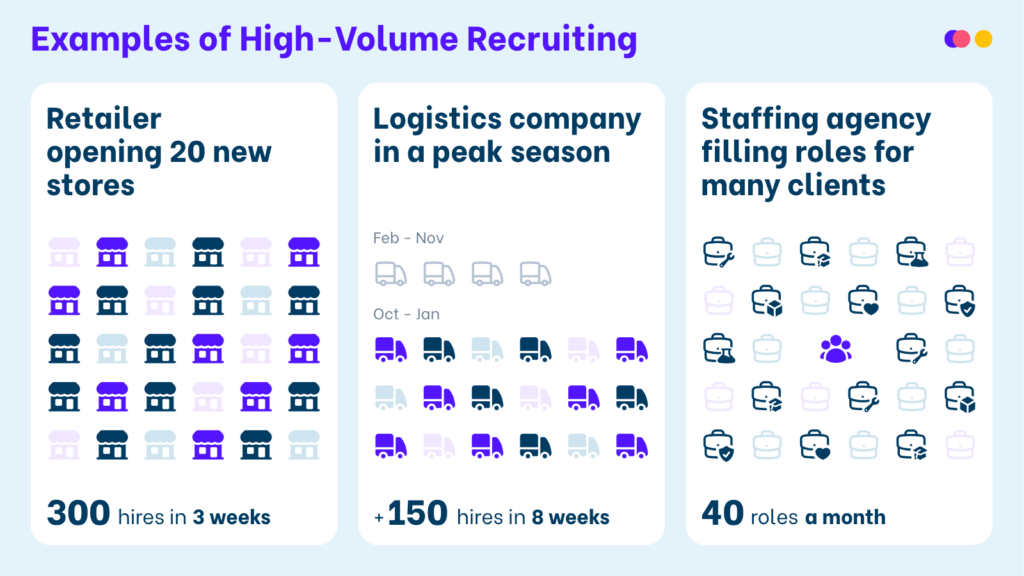
You may find it difficult to know what exactly counts as high-volume hiring and in what situations it’s needed. Below are three examples of scenarios where high-volume hiring typically shows up. These include:
- A retailer opening 20 new stores in different locations
- A logistics company preparing for peak season
- A staffing agency filling roles for multiple clients
Example 1: A Retailer Opening 20 New Stores in Different Locations
A company may need to hire 15 people per store in the six weeks before launch. That’s 300 hires in a month and a half, with each location needing its own channel mix since different job boards may work better in different locations.
Example 2: A Logistics Company Preparing for Peak Season
A warehouse team of 150 may need to double in size from October to December. They’d need more packers and delivery drivers to handle the inflow of orders from Black Friday through Christmas, as well as the potential wave of returns in January. That’s 150 more hires in about eight weeks – all the while every other retailer and courier is competing for the exact same people within that same time period.
Example 3: A Staffing Agency Filling Roles for Multiple Clients
An international staffing agency may need to fill 40 roles a month for clients across different sectors and locations. Think care assistants for a healthcare group, cashiers for a retailer, and pickers for a logistics client all at the same time. That’s nearly 500 placements each year, with different requirements in shift patterns and start dates across industries.
High-Volume Hiring vs. Traditional Recruiting
The way recruiters approach high-volume hiring is different from traditional recruiting.
Traditional recruiting – think a new CFO or a regional sales director – is careful and targeted. You take the time to source, screen, and interview a handful of strong candidates for a single role.
High-volume hiring – such as truck drivers or warehouse associates – demands the same quality, just at a very different speed. You still need the right people, but you need a lot of them, and you usually need them fast.
This typically comes with a couple of key distinctions in the hiring process, detailed below.
Traditional recruiting | High-volume hiring | |
|---|---|---|
Application volume | Dozens of per role | Hundreds per role, thousands per campaign |
Speed | Weeks to months | Days to weeks |
Screening | Manual CV review, recruiter calls | Knockout questions, automated, and AI-assisted pre-screening |
Decision-making | Individual judgement per candidate | Consistent criteria applied at scale |
Team coordination | One recruiter, one hiring manager | Recruiters, site managers, and HR spread across many locations |
Cost of mistakes | A bad hire is costly but rare | Small inefficiencies multiply across hundreds of hires |
Main KPIs | Quality of hire, time to hire | Time to fill, cost per application, cost per hire, drop-off |
Job ad budget | One job board or a fixed annual contract | Many channels at once, with budget moved to what performs |
Industries and Companies That Rely on High-Volume Recruitment
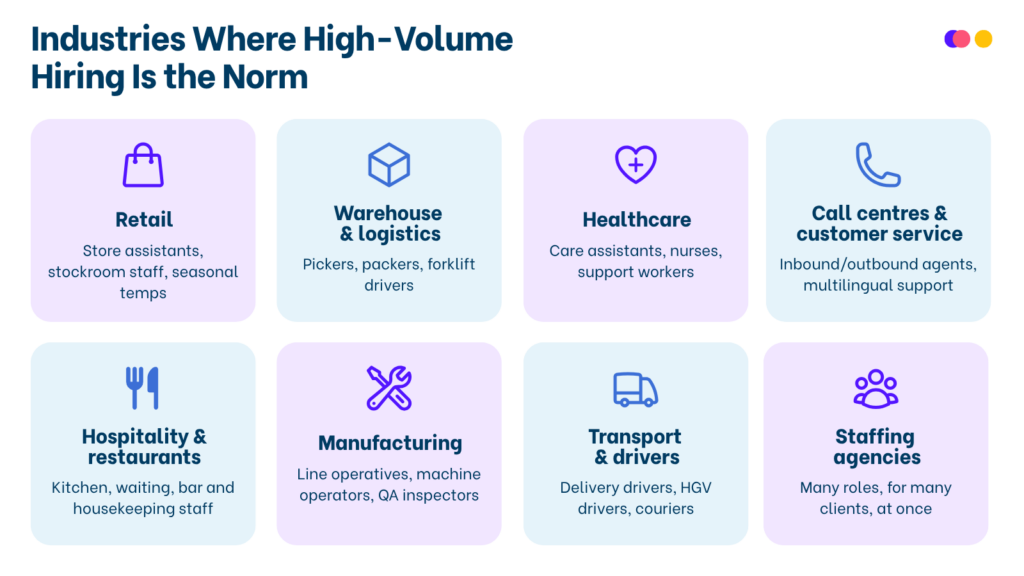
We briefly covered examples of instances where high-volume hiring may occur. This section dives a bit deeper, highlighting industries where hiring at volume is the standard. At a glance, these are:
- Retail
- Warehouse and logistics
- Healthcare
- Call centres and customer service
- Hospitality and restaurants
- Manufacturing
- Transport and drivers
- Staffing agencies
Retail
Retailers need to hire store assistants, stockroom staff, and seasonal temps, often dozens per location at once. The volume is amplified during hiring peaks ahead of new store openings and special occasions such as Black Friday and Christmas, when unfilled shifts cause disruptions on the shop floor.
Warehouse and Logistics
Pickers, packers, forklift drivers, and shift supervisors make up most of warehouse and logistics hiring. In this industry, demand picks up from October to January with e-commerce volumes climbing and peak-season contracts coming in full swing.
Healthcare
Care assistants, nurses, support workers and cleaning staff are needed across many sites at once, and turnover is consistently high. As we covered in our look at Europe’s healthcare staffing crisis, those shortages aren’t going away any time soon.
Call Centres and Customer Service
Call centres hire inbound and outbound agents, as well as team leaders and multilingual support staff. Hiring tends to follow new client contracts and product launches, and with staff turnover consistently high, recruitment in this space rarely slows down.
Hospitality and Restaurants
Kitchen staff, waiters, bar staff, and housekeeping teams are needed in large numbers before summer and the festive season. Many of those roles have to be filled in a matter of weeks, which means slow, single-channel advertising is rarely enough to reach the necessary hiring volumes.
Manufacturing
Manufacturers recruit production line operatives, machine operators, and quality inspectors, with volume spiking when a new production line or extra shift is added.
Transport and Drivers
Delivery drivers, HGV drivers, and couriers are in constant demand, whether it’s for e-commerce deliveries or long-haul freight between warehouses and stores. These roles often need extra checks during hiring, such as licence type and right to work, which makes fast, structured screening essential.
Staffing Agencies
Recruitment agencies typically recruit at volume for many clients at once, often filling 40+ roles a month across different sectors and locations. For them, high-volume recruitment is the day-to-day reality rather than a one-off during seasonal peaks.
Advantages and Disadvantages of High-Volume Recruitment
Hiring at volume comes with real upsides when your process is built for it – and real risks when it isn’t. Here’s how the two sides stack up.
Advantages of High-Volume Recruitment
The most obvious advantage is speed. A repeatable process – the same job ad templates, screening questions and interview formats for every role – gets new hires in place before the deadline, rather than after it. That matters more than it might seem: Kellogg research found that doubling the time it takes to fill a vacancy leads to a 3% drop in profits.
High-volume recruitment also gives you flexibility. When hiring at scale is a well-oiled process rather than a scramble, you can grow your workforce for peak season and scale it back down afterwards without disrupting day-to-day operations. Not only that, but advertising across many channels reaches candidates your go-to job board never sees. Every campaign also leaves you with a pool of past applicants you can go back to (with their consent) for future roles.
Then there’s the efficiency gain. Recruiters spend around 10 hours a week on manual job advertising alone, according to Aptitude Research. Structured screening and automation give that time back for interviewing and getting to know the best-fit candidates. And because the cost of job ads, screening and onboarding is spread across many hires, cost per hire tends to fall at volume – especially when your budget consistently moves to the channels that bring in fit applicants.
Disadvantages of High-Volume Recruitment
The biggest problem in high-volume recruiting isn’t always bandwidth. While yes, businesses are often overwhelmed with applications and don’t have enough recruiters to handle them all, the real issue is money, as budget drips away when job ads are still managed by hand.
Aptitude Research found that up to 40% of job advertising budgets is wasted on inefficient cost-per-click (CPC) deals and manual, infrequent optimisation. Hiring budgets are locked in annual contracts with job boards with inconsistent performance. Either that, or it gets spread across ten providers with ten dashboards and no bird’s eye view of what’s actually contributing to the hiring pipeline. Coupled with climbing costs – with a 27% spike in CPC in 2024 alone.
To put this into perspective, imagine a €100,000 annual job ad budget. Even if only a quarter of that 40% figure applies to you, that’s €10,000 a year going to channels that were never going to deliver. That’s enough to fund several hiring campaigns.

Wondering how much of your spend is going to waste?
Here are 10 ways you’re wasting your recruitment budget (without realising it).
Beyond cost, you may be dealing with the operational headaches of an unfit high-volume hiring workflow.
Hundreds of CVs per role create a screening bottleneck, with the best candidates often left waiting in the queue. That costs you more than hires – it also shapes how people see your company. Candidates who don’t hear back are quick to share it, whether that’s in a review on Glassdoor or Indeed or in a conversation with friends who might have applied next. And in high-volume sectors like retail and hospitality, today’s ignored applicant is often tomorrow’s customer, so a poor hiring experience can follow them right to the till.
Slow replies and long application forms also push applicants towards the next employer, at a time when time to hire has crept up from 45.7 to 46.2 days in a single year.
High-Volume Recruitment Trends in 2026
The high-volume hiring landscape looks very different to how it did even two years ago. Here are some of the high-volume recruitment trends shaping the space in 2026:
- More applicants, fewer hires: applications are up, but hiring doesn’t follow suit. Applicants per job posting roughly doubled, from about 46 in 2021 to 95 in 2025, while the hiring rate kept falling.
- The rise of AI-generated applications: candidates are using AI to apply faster and more often, and it’s adding to the pile – often with unfit candidates. On top of that, 67% of UK hiring managers say the surge in AI-generated applications drags out hiring.
- Automation still lags behind: 62% of organisations say hiring automation is more critical than last year, yet 99% don’t use AI voice screenings, which can help qualify applicants within minutes, at any hour.
- More roles to fill with leaner teams: with smaller teams handling more openings, more efficient approaches to high-volume recruitment is a must for teams looking to scale hiring.
- Job board costs keep climbing: with CPC up, more teams are spreading spend across channels and moving budgets to the ones that convert, rather than paying more for the same results.
- Shorter application forms are preferred: application forms that drag on can lose you candidates. 60% of frontline workers have started an application without finishing it, and six in 10 have abandoned one because it was too lengthy or unclear.
- A push toward pay transparency: the EU Pay Transparency Directive requires employers to share starting pay or a pay range with candidates before the interview, which aligns with candidate expectations since 31% of frontline workers who abandoned an application cite a lack of pay transparency.
- AI in hiring gets regulated: the EU AI Act classes AI used in hiring decisions as high-risk, with obligations for employers due from 2 December 2027. This means a tool can’t simply auto-reject thousands of candidates without oversight. A human needs to make the final decision, with every step needing a record.
7 Steps to High-Volume Hiring
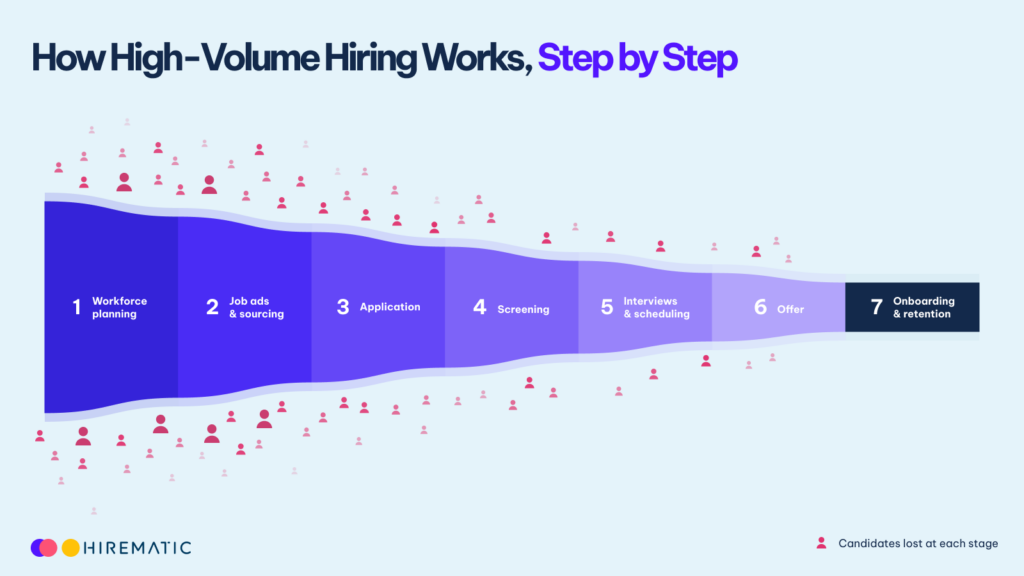
High-volume recruitment moves candidates through seven key stages. Think of it as a funnel where every leak is multiplied by the number of roles you’re hiring for – so the goal is to lose as few good people as possible between each stage.
1. Workforce Planning
Start by agreeing how many people you need, where, by when, and on what budget. At volume, this is also the moment to group roles that share requirements, so you can reuse job ads, screening questions and interview formats instead of building each one from scratch.
2. Job Ads and Sourcing
Write short, clear job ads that state the role, location, shifts and pay up front, then get them in front of the right candidates across several channels. The goal isn’t to appear everywhere, but to show up on the channels where your applicants actually are.
3. Application
Make applying quick and mobile-friendly, ideally under two minutes. Every extra field or redirect is a chance for a candidate to drop off, and at volume, those drop-offs add up fast.
4. Screening
Use deal-breaker questions and structured pre-screening to shortlist quickly and fairly. Asking about right to work, licences or shift availability up front means recruiters only spend time on applicants who can actually take the job.
5. Interviews and Scheduling
Let candidates book their own interview slots, and use group or short-format interviews where it makes sense. The faster someone moves from application to interview, the less likely they are to accept an offer elsewhere.
6. Offer
Make offers quickly and keep them simple. In competitive markets, the employer who confirms first often wins the hire.
7. Onboarding and Retention
Get new starters productive fast with a clear first week, then keep track of who’s still with you after 90 days. Early turnover is usually a sign that something earlier in the funnel – the job ad, the screening or the offer – needs adjusting.
10 Ways to Successfully Hire at High Volume
Most of these approaches to high-volume recruitment shouldn’t come as a surprise. They’re applicable for standard hiring as well. What makes the difference at volume is doing them consistently across every role and every channel, at the same time.
- Tighten the role: write short, mobile-friendly job ads that say exactly what the job is, where, when and for how much. Here’s how to write recruitment ads that convert.
- Let performance data choose your job titles and locations: small changes can compound – quickly, that is. In one Hirematic campaign, optimising the job title, description and geo-targeting took cost per application from £2 to £1.20 and daily applications from 5 to 20. See how job titles affect application rates.
- Cast a wide net: advertise across job boards, search and niche sites, not just the one or two channels you’ve been relying on.
- Move budget to the channels that convert: rather than locking spend into one board for a year, shift it continuously to wherever you’re getting the best applications at the best cost. Read more on this in our guide to ROI optimisation in recruitment marketing.
- Shorten the apply flow: keep forms short and mobile-friendly with tools like 1-Click-Apply, which delivers up to 4x higher conversion than sending candidates to an external careers site.
- Pre-screen promptly with deal-breaker questions: ask the must-haves up front (right to work, licences, location, shift availability) so recruiters only spend time on qualified applicants.
- Respond and schedule fast: at volume, speed is a competitive advantage. The longer candidates wait to hear back, the more likely they are to accept an offer elsewhere. Automate application confirmations and next-step messages, and let candidates book their own interview slots instead of going back and forth by email.
- Get in touch with past applicants: last campaign’s silver medallists can be this campaign’s fastest hires, as long as you have their consent to get back in touch.
- Stop when you have enough applicants: too many applications can be as big a problem as too few. Set a limit on how many applications each role collects, so campaigns pause automatically once you have a manageable pool, and budget isn’t spent on candidates nobody will have time to review. With Spend Management & CV Limits, you can do just that.
- Track the full funnel, not just clicks: clicks don’t fill shifts, but actual hires do. Track cost per application, cost per hire, and retention to see what’s really working so you know what to double down on.

Metrics to Measure When Hiring at Scale
Small changes in your numbers can seem insignificant in isolation, but they compound at scale. A two-point drop in apply conversions is barely noticeable on one job ad, but across 200 roles it can mean hundreds of missing applicants.
To make sure you’re headed in the right direction when it comes to your approach to volume recruitment, keep an eye on these key recruitment metrics in a high-volume setting:
Metric | Why it matters at volume |
|---|---|
Time to fill | Shows whether you'll hit your deadline for a store opening or peak season |
Time to hire | Shows how fast you move once a candidate applies, before they accept another offer |
Cost per application | Tells you which channels deliver applicants efficiently |
Cost per effective application | Strips out duplicates and unqualified applicants, so you see the cost of applications you can actually use |
Cost per hire | The number your finance team cares about most |
Apply conversion rate | Shows how many job ad viewers actually finish applying |
Screening pass rate | Reveals whether your ads are attracting the right people |
Candidate drop-off | Highlights the stage where you're losing people |
Offer acceptance rate | Points out issues with pay, speed, or candidate experience |
90-day retention / quality of hire | Shows whether fast hiring also translates to good hiring |
The Tech Stack Behind High-Volume Hiring
No single tool does everything, but that’s to be expected. Most high-volume teams build their stack from the ground up using a handful of tools, each covering a different stage of the funnel. We’ll cover what each one of these does, and why it matters at every step of the way when you’re hiring at scale:
- Applicant tracking system (ATS)
- Recruitment advertising and programmatic job advertising
- Screening and conversational AI
- Interview scheduling
- Candidate assessments
Applicant Tracking System (ATS)
Your ATS collects applications, stores CVs, and tracks every candidate from first screen to offer. At volume, its job is to keep hundreds of applicants organised, so nobody is unaccounted for and every hiring manager sees the same pipeline. If you don’t have ATS, some platforms like Hirematic still let you create and run jobs without one.
Recruitment Advertising and Programmatic Job Advertising Tools
This is where your candidates come from, and where most of your hiring budget goes. When you’re running dozens or hundreds of job ads at once – which is what you’ll be doing if you’re hiring at scale – posting manually to each job board and checking ten different dashboards won’t scale.
Programmatic job advertising tools like Hirematic distribute your job ads across many channels and reallocate budget based on live performance. That is: if one board is bringing in strong, affordable applications and another isn’t, the budget moves to the one that works – which is just one of the benefits of programmatic job advertising.
Screening and Conversational AI Tools
Once applications roll in, screening tools take the first pass. That means must-have questions and structured shortlisting, so recruiters spend their time on the applicants worth talking to. The best tools suggest and recruiters decide, which is also where regulation is heading. Read our take on automated decision-making in recruitment for where automation should stop and human judgement should take over.
Interview Scheduling Tools
Scheduling tools let candidates pick an interview slot straight from the recruiter’s calendar. At volume, that cuts out hours of back-and-forth emails each week and gets candidates booked the moment they’re interested, instead of waiting for recruiters to get back to them.
Candidate Assessment Tools
Short skills tests, job previews, or situational questions help you check what a CV can’t, such as whether someone can handle a forklift, a busy till or a difficult customer call. Keep them brief and mobile-friendly: at volume, every extra minute in the process costs you applicants.

Upgrading your recruitment tech stack?
Our guide on choosing the best recruiting tools for your teams walks you through the process.
How Hirematic Helps With High-Volume Recruiting Initiatives
When you’re hiring at volume, managing job advertising across a handful of job boards can end up turning recruiters into campaign managers – a job they weren’t meant to take on, and one that distracts them from building trust with viable candidates. This is exactly where Hirematic comes in to take care of job advertising needs.
Think of Hirematic as the operating layer for your recruitment advertising. It’s AI-assisted, with an expert team behind it, and it does the heavy lifting across your whole channel mix. That is:
- Pay-per-performance and pay-per-slot channels under one system: Hirematic folds your existing job board contracts and credits into the platform, so nothing goes to waste and nothing has to be managed on the side.
- Aimed distribution, not spray-and-pray: each job ad goes to the best-fit channels from the Hirematic Partner Network of hundreds of niche and general job boards.
- AI job ad intelligence: before an ad goes live, Hirematic suggests alternative job titles, uses historical performance data for geo-targeting, and flags potentially exclusionary language.
- Flexible control, not a switch: hand the performance layer over to automation, or set your own budget and credit allocation per channel. With Spend Management & CV Limits, you can also cap how many applications each role collects.
- Full-funnel visibility: cost per application, cost per shortlist, and cost per hire visible at every stage, in one consolidated dashboard instead of ten individual ones for each job board.
- One contract and one invoice for the entire network, including your existing Indeed account, with applications delivered straight into your ATS through integrations with 100+ ATS and HR platforms.
Not only that, but you get a dedicated account manager who knows your campaigns and helps you get more from them.
Meet Hirematic in 90 seconds
High-Volume Hiring Success Stories Using Hirematic
Here’s what high-volume hiring looks like when the hiring budget follows performance and helps you reach your hiring goals.
Ferrero: 40 Hires a Month, 35% Lower Cost per Application
Ferrero needed to fill 40 positions a month at one of its facilities in Italy. It was running separate campaigns across three online channels, at an average cost per application of €26, plus the time spent managing each channel by hand.
Over a 16-week campaign with Hirematic, its job ads were distributed and optimised across channels from a single platform. The result? 1,606 applications on a budget of just over €27,000. Ferrero brought in the same number of applications as its previous campaigns, but at a 35% lower cost per application, saving €13,000 from its ad budget.

Mitsubishi Electric: 1,000 Applications in One Month
Mitsubishi Electric needed specialised mechanical assembly workers for a plant in Italy, in a region where competition for skilled labour was fierce. Until then, it had relied on managing its job ads manually.
For a one-month hiring drive, Hirematic targeted its job ad spend at the right locations and optimised the campaign in real time. Within four weeks, the campaign generated 1,000 applications and cut the average cost per application by almost 50%, saving close to $50,000 in a single month.
UK Staffing Agency: 4x More Applications per Day
A mid-size UK staffing agency needed a steady flow of applicants for 10 vacancy types, mostly sales roles for clients with high staff turnover. At five applications a day and £2 per application, it couldn’t keep up with client demand.
Hirematic’s AI suggested better job titles and keywords, expanded targeting into overlooked locations, and A/B tested each job ad. The result? In under six months, daily applications grew from 5 to 20, cost per application fell 40% to £1.20, and unqualified applicants dropped by 15%.

High-Volume Recruiting FAQ
What is considered high-volume recruiting?
High-volume recruiting usually means making hundreds or thousands of hires a year, filling many openings for the same role at once, or receiving hundreds of applicants per role. A tight deadline, such as a store opening or peak season, is often part of the picture too.
What is the difference between high-volume and regular recruiting?
Regular recruiting focuses on finding a few strong candidates for one role, with time for detailed screening. High-volume recruiting fills many roles fast, so it relies on structured screening, automation, and multi-channel job advertising at scale to keep speed and quality in check and balanced.
Is high-volume recruiting the same as mass recruitment or bulk hiring?
Yes. High-volume recruiting, high-volume hiring, mass recruitment, volume recruitment and bulk hiring all describe the same thing: hiring a large number of people in a short time, usually for similar roles.
What companies use high-volume hiring?
Retailers, warehouse and logistics companies, healthcare providers, call centres, hospitality businesses, manufacturers, transport firms, and staffing agencies are the biggest users. Any organisation with seasonal peaks, high turnover, or sudden, rapid growth may require it.
How do you measure high-volume recruiting success?
You can track metrics like time to fill, cost per application, cost per hire, candidate drop-off, and 90-day retention. Together, they show whether you’re hiring fast, efficiently, and well.
Can you do high-volume hiring without increasing your job ad budget?
Often, yes. Many teams lose a large share of their budget to channels that don’t convert. Moving spend to the channels that deliver the best applications at the best cost, and shortening the application flow, usually brings in more hires from the same budget. It’s all about optimising your approach to hiring.
