Most businesses think that reducing recruitment costs is just a matter of spending less on job boards. In reality, it’s not the most observable costs that drain your recruitment budget, but the insidious ones that are to blame.
In this article, we break down 10 ways your recruitment budget and advertising costs may be leaking across visible, operational, and structural domains. These costs are made up of:
- 1. Escalating cost-per-hire
- 2. Defaulting to inefficient channels
- 3. Budget locked where performance isn’t
- 4. Vacancy costs that compound
- 5. Manual process drag
- 6. Hiring twice for the same role
- 7. Outgrowing your hiring capacity
- 8. A tech stack that works against you
- 9. A brand that repels candidates
- 10. Optimisation done in silos
Visible Waste
The first recruitment budget leakages that come to mind are in the visible spend category. They’re also typically the primary costs recruitment teams address when looking to reduce spend.
The three types of visible waste include:
- Escalating cost-per-hire
- Defaulting to inefficient channels
- Budget locked where performance isn’t
1. Escalating Cost-Per-Hire
If there’s one thing recruitment teams can agree on, it’s this: recruitment costs have generally been on the rise – with no signs of slowing down. But that doesn’t mean spending on all roles have been impacted equally.
For example, while non-executive cost-per-hire (CPH) has decreased, executive CPH has more than doubled since 2017. This is a byproduct of a more competitive labour market, with the CIPD reporting that 70% of businesses face increased competition for well-qualified talent, leading to more money being spent on attracting and converting viable candidates.
2. Defaulting to Inefficient Channels
Recruitment advertising budgets that are consistently funneled toward a select few job boards, irrespective of what roles you’re hiring for, may feel like instant visibility. But when there’s a mismatch between the role and the channel, that visibility either reaches the wrong audience or fails to bring meaningful results.
For example, if you’re hiring blue-collar roles but direct most of your budget to a premium job board because “you’ve always done it this way,” you may end up with a high volume of unqualified applicants that suck up recruiters’ time while delivering little to no eligible candidates in return.

3. Budget Locked Where Performance Isn’t
Some costs are automated into your hiring processes through subscriptions, often without much thought on a monthly basis. This includes job board subscriptions or long-term contracts with chosen recruitment tools – both of which may go unused by recruiters. These costs aren’t inherently inefficient, as they can provide ongoing access to candidates and capabilities when used effectively, but they can result in waste if teams aren’t careful in overseeing their use.
Operational Waste
Operational waste comes from inefficiencies in your day-to-day processes. These come in the form of delays or manual-heavy workflows that snowball costs over time. Unlike visible waste, which can usually be quantified from the get-go, operational waste is buried deep in the inefficiencies of your hiring processes. Some examples of these cost leakages include:
- Vacancy costs that compound
- Manual process drag
- Hiring twice for the same role
- Scaling without operational capacity
4. Vacancy Costs That Compound
According to SHRM, “both nonexecutive positions and executive positions are more frequently filled externally than internally,” which typically means longer hiring cycles, with time-to-hire increasing from 45.7 to 46.2 days in the last year alone. These longer cycles drive up the “cost of vacancy,” which is a series of costs that compound based on the:
- Extended spend on job ads and sourcing
- Increased recruiter workload
- Diminished productivity as team members take on additional responsibilities
- Lost revenue if the role is directly tied to sales
5. Manual Process Drag
Despite numerous AI-based automated recruitment tools on the market, some recruiters still choose to do things manually. This includes tasks such as posting job ads, screening applicants, coordinating and scheduling interviews, and filtering through incoming candidates.
While this might’ve been feasible when hiring volumes were low, recruiters now manage around 15-20 active job openings at a time. This turns manual tasks that once seemed like quick jobs-to-be-done into hours of work. Not only does this leave room for errors, but it’s also time-consuming and unproductive, resulting in further add-on operational costs.
6. Hiring Twice for the Same Role
Recruitment costs don’t always come to a halt once hiring’s done. In some cases, they keep on piling, particularly if a new employee turns out to be an improper fit. Unfortunately, this happens more often than you might think, often unpredictably so.
A 2025 Benchmark Report by SHRM revealed that 61% of recruiting executives believe a lack of qualified candidates is a major challenge. To add to this, few organisations actually measure the success of their hires, with only 20% of companies using quality-of-hire metrics in 2025 – a 7% drop since 2022.
These blind spots mean you’ll end up paying twice to fill the same role if you want to keep costs productive.
7. Outgrowing Your Hiring Capacity
Atlas’ 2026 Report revealed that 35.6% of recruiters find their workload overwhelming – the inevitable result of shrinking headcounts and increasingly high performance expectations.
Recruiters now have to stretch themselves thin, covering more open roles and candidate pipelines simultaneously. This leads to uneven outcomes and human error (e.g., inconsistent candidate experiences) that can not only tarnish hiring results but also brand perception, impacting employer branding.
Structural Waste
The structural waste that builds up as part of your recruitment activities is rooted in your systems – the tools, data, and decision-making levers that dictate how you allocate and redirect budget across recruitment activities. This means:
- A tech stack that works against you
- A brand that repels candidates
- Optimisation done in silos
8. A Tech Stack That Works Against You
A poor recruitment tech stack can cost your teams precious time, simultaneously giving rise to inefficiencies that recruiters can’t turn a blind eye to.
A 2025 study revealed that 65% of recruiters felt that ineffective tech, market insights, and recruitment analytics had the most detrimental impact on recruiting. And quantitative findings corroborate this, as improvements to your tech stack can reduce costs by 12% and improve hiring speed fourfold.
9. A Brand That Repels Candidates
Employer branding initiatives such as social media campaigns are typically the last thing on recruiters’ minds – but that doesn’t make it any less important. Proactively creating an attractive employer branding campaign can not only increase your exposure to qualified applicants but also reduce conversion costs, in some cases by up to 43%.
10. Optimisation Done in Silos
Optimising campaign performance – reallocating budget to successful channels, refining targeting – is a must if you want to keep recruitment costs under control. But just ticking them off your to-do list doesn’t automatically guarantee results.
This is especially true if you make optimisations in isolation – per channel, role, or at the individual recruiter level – based on partial performance insights rather than using a complete, bird’s eye view of your data.
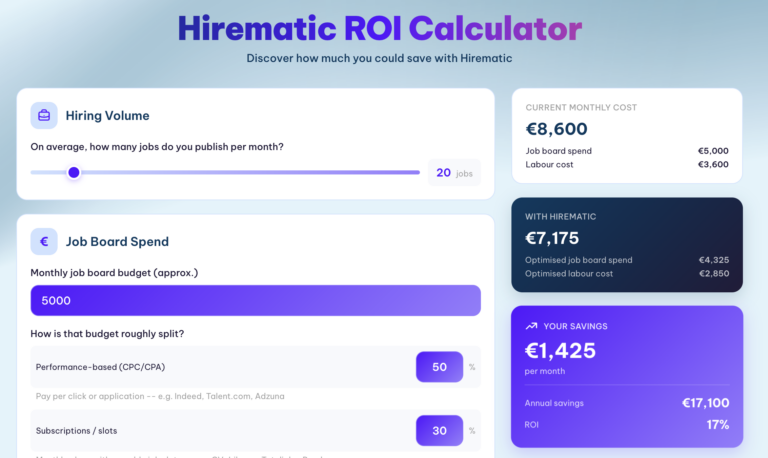
Want to See What This Waste Could Be Costing You?
Most of these recruitment inefficiencies don’t look dramatic if you look at them separately. But with costs spread across recruiter time, job board spend, and missed opportunities for optimisation, they can quickly inflate costs – often without you noticing until it’s too late.
It accounts for the hidden costs present in recruitment advertising and uncovers potential areas for optimisation so you can use it to calculate your current recruitment advertising costs and find out your potential savings.