


Outdated hiring approaches like manual recruitment advertising persist not because they’re better, but because recruiters are risk-averse and fearful of change – even if that change comes with clear benefits and a near-guarantee of improved results.
But while sticking to what’s comfortable might feel safer in the short-term, the cracks of recruitment inefficiency are bound to rear their ugly head in the long run. And you might just realise you’ve been bleeding more money than you might’ve thought.
In this article, we’ll talk about the true cost of manual recruitment advertising – what it is and how it impacts your recruitment results, using facts and figures to quantify impact.
We’ll cover:
What is Manual Recruitment Advertising?
Manual recruitment advertising is the traditional way of creating, distributing, and publishing job advertisements across different channels and job boards.
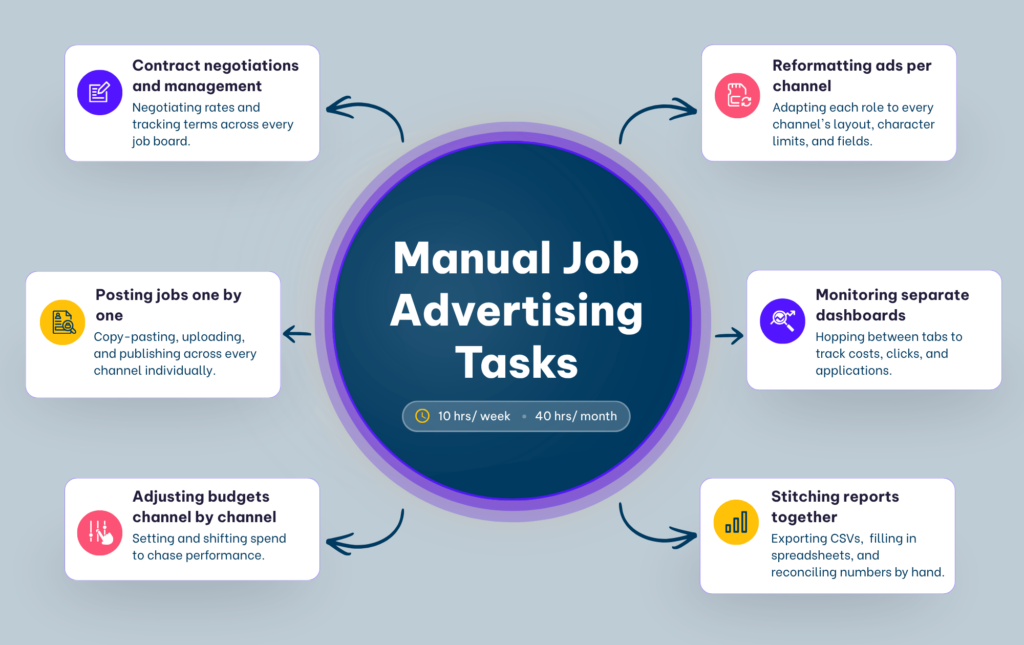
Tasks typically involve:
- Choosing job boards (e.g., Indeed, industry-specific niche job boards, social channels)
- Crafting and adapting job ad copy and formats to fit each channel
- Attributing budgets to each job board and channel individually
- Monitoring job ad performance (views, applications) by accessing each channel’s dashboard
- Pausing and boosting campaigns – or reallocating budget – manually based on periodic reviews
Why Manual Recruitment Advertising Isn’t Sustainable
While some recruiters still choose to do things manually, there’s been a widespread shift away from hands-on recruitment advertising practices across industries. When comparing manual approaches to tech-forward ones like programmatic, companies that want to hire the best talent opt for the latter.
Giants such as Ferrero Group and Mitsubishi Electric chose to automate their recruitment advertising workflows for two reasons:
- 1. Recruitment demands grow while teams shrink
- 2. Posting and adjusting job ads blindly comes with unexpected costs
1. Recruitment Demands Grow While Teams Shrink
No matter how you look at it, doing things by hand will always take up a lot more time than most teams can afford. Even with shortcuts, you’re still unlikely to match the speed and efficiency of an automated solution.
As Madeline Laurano, founder of Aptitude Research, put it:
"Traditional advertising is incredibly expensive, it’s incredibly inefficient, and it creates inefficiencies in talent acquisition."
Couple this with shrinking team sizes, and the pressure doesn’t just mount, but compounds.
Admin Time Drain
Recruiters spend an average of 10 hours a week on manual job advertising. That’s 40 hours a month – a full work week – wasted on setting up and managing job ads manually.
Multiply that by the number of recruiters in your team and you’ll soon realise that you’re spending a lot of time and money before a single candidate is even spoken to. That is, excluding the necessary human work involved in recruitment – interviewing, assessing, hiring.
Leaner Recruitment Teams
Not only are recruiters spending 25% of their work week on recruitment advertising, but they’re also dealing with an increasingly higher workload and tighter recruitment budgets.
According to RallyFwd’s 2024 report, 57% of recruitment marketing professionals identified the lack of budget and resources as their biggest challenge. At the same time, Gem’s 2025 Recruiting Benchmarks Report revealed that recruiter headcount per team shrank by 23%, with the average recruiter now managing 56% more open roles and 2.7x more applications than before.
What This Means In Monetary Terms
To bring the financial impact of manual recruitment advertising into focus, let’s look at what this means in practice.
Based on salary data aggregated across Western European markets, the average recruiter salary sits between €45,000-€50,000 per year. Using €47,000 as our yearly baseline, that’s:
- €24.45 per hour (based on standard 40-hour week)
- 10 hours per week spent on manual job advertising alone
That’s €244.50 per recruiter, per week, just on manual advertising admin. Monthly, that’s nearly €980 per recruiter in wage costs attributed purely to tasks that automation could handle. And that’s before factoring in the missed opportunities, human error, and inefficiencies that come with an overworked team stretched thin across tasks that shouldn’t require human time.
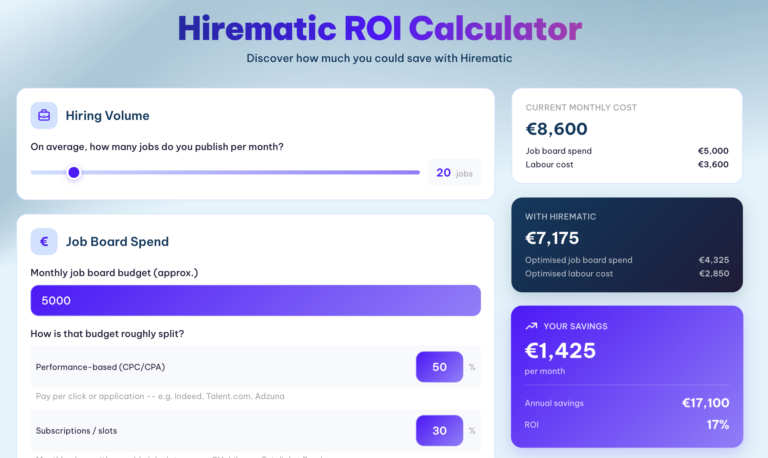
Calculate the cost of your recruitment advertising efforts
2. Posting and Adjusting Job Ads Blindly Comes with Unexpected Costs
Wages and time spent on recruitment advertising are one thing. But the costs that are harder to pinpoint – and typically drip on in the background unnoticed – are those linked to job board spend.
What makes them so difficult to quantify is that they’re driven by the inevitable limitations of human judgement: biases, blind spots, and impaired oversight.
These show up as:
- Bias driving job board decisions
- The inability to keep up with real-time performance
- Slow decision-making stretching time-to-fill
Bias Driving Job Board Decisions
Some recruiters rely on a fixed set of job boards for all of their postings, using their previous experience as justification. While this approach can work when hiring needs are consistent, it’s not effective in agency environments.
If recruiters hire for different jobs across a wide range of industries, regions, or countries – all of which come with their own set of market factors – a copy-paste approach will inevitably lead to wasted spend.
Typically, this takes the form of rolling subscriptions or annual contract agreements with job boards, where recruiters end up locking themselves in regardless of what results show.
More often than not, these decisions aren’t data-driven or rationally thought out. Rather, they’re driven by two biases:
- Sunk cost fallacy, which keeps teams paying for platforms they’ve previously already invested in
- Status quo bias, which keeps them from questioning whether these platforms are the right fit

The Inability to Keep Up with Real-Time Performance
Even if recruiters expand their channel mix beyond subscription-based channels to include CPA-based or programmatic channels, that doesn’t automatically mean their recruitment advertising is optimised.
Since performance-based channels only optimise spend within themselves – adjusting bids and placements based on live data – they don’t account for what’s happening across the rest of your channel mix.
In practice, it just means you’re adding a new self-optimising channel to a fragmented mix that still relies on manual adjustments.
Without a unified, bird’s eye view of total spend and performance across all channels, manual adjustments can only be so effective. When each channel runs its separate dashboard – operating using its own pricing model and success measures – any manual adjustments that are made are likely to be erroneous, based on incomplete data, or outdated by the time they’re implemented. At best, this makes recruitment methods only partially optimised at all times.
This is exactly where Hirematic comes in to fill the gaps.
Our AI-powered recruitment tool automatically distributes your job ads to the best fit channels according to job type, industry, and location. It then continuously optimises your budget and channel mix so spend always ties into results. For full visibility, your Hirematic dashboard consolidates performance data from all channels in one place, giving you a bird’s eye view of your pipeline and recruitment metrics without requiring you to access each job board or channel separately.
Discover Hirematic in 90 seconds
Slow Decision-Making Stretching Time-to-Fill
The lack of (or slow) recruitment advertising optimisation brought on by manual processes doesn’t just affect the CPA, CPH, or job board spend. It stretches out time-to-fill, too.
The slower you are to fill a position, the more money it’s costing you in the long run – especially if you’re hiring for revenue-generating roles. According to KelloggInsight, doubling the time it takes to fill a job vacancy results in a 3% drop in profits.
One can only imagine how much larger the toll on your bottom line would be when hiring for mission-critical or revenue-generating roles at scale.
The Impact of an Automated Recruitment Advertising Alternative
An automated recruitment marketing solution like Hirematic does the heavy lifting for recruiters by freeing them from having to act like campaign managers. Instead, they can focus on the human legwork involved in recruiting (interviewing, shortlisting, building candidate relationships.)
The result isn’t just an increase in efficiency, but better hiring outcomes at a fraction of the cost – as was the case with Mitsubishi Electric’s case study.
Tasked with hiring specialised mechanical assembly in a competitive regional labour market with a tight budget, Mitsubishi Electric turned to Hirematic’s AI-driven omnichannel recruitment platform for a one-month intensive hiring initiative.
The results speak for themselves:
1,000
applications in a single month
50%
drop in CPA compared to their previous manual approach
€50k
in budget savings
Want to Make the Switch Away From Manual Recruitment Advertising?
If you’re done with the hassle and downsides of distributing and managing job ads by hand, using an AI-powered solution like Hirematic to automate and optimise your channel mix and budget may be the natural next step.
We understand how daunting this change can be for recruiting teams who’ve always done their recruitment marketing by hand. So at Hirematic, we’ve made it our mission to simplify the process – for non-technical teams especially.
Our recruitment marketing experts support you at every step of the process, while our technology enables one-click integrations with 110+ Applicant Tracking Systems. This makes both the onboarding process and the technical setup a breeze, without you having to upend any of your existing hiring processes.
Ready to take the leap and see what Hirematic can do for you? Book your demo right away.
