If you ask hiring teams to tell you how much they’re spending on recruitment advertising, you’ll probably leave them scratching their heads. Most don’t know the true cost of their recruitment advertising efforts – or the moving parts that contribute to it.
As hiring costs increase (with both cost-per-application and cost-per-hire spiking in the last year alone) understanding how much you’re paying for your recruitment marketing initiatives is more important than ever if you want to keep costs under control.
In this article, we’ll help you understand what drives your recruitment advertising costs and what you need to do to calculate them. We’ll discuss:
What Is Your Recruitment Advertising Cost Made up Of?
Recruitment costs aren’t driven by a single factor. They’re the result of a combination of cost drivers that interact with one another and often fluctuate with time.
At a high level, your recruitment advertising costs can be split into three categories:
- Media spend
- Internal labour
- Operational complexity
Calculating total media spend and internal labour costs is relatively simple if you have accurate data on hand. The real (and often hidden) costs are driven by operational complexity, as inefficiencies ramp up spending behind the scenes.
1. Media Spend
Your media spend is the budget you allocate across job boards and other recruitment channels. Since different channel types have their own pricing models, the way you split your media budget across channels impacts the predictability, control, and efficiency of your recruitment advertising spend.
The most common job channels fall in these categories:
- Performance-based job boards
- Subscriptions/slot-based job boards
- Pay-per-post/credit-based job boards
Performance-Based Job Boards
When using performance-based job boards (e.g., Indeed, Adzuna), you pay directly for outcomes – typically on a cost-per-click (CPC) or cost-per-application (CPA) basis.
Since costs are influenced by real-time market dynamics – role demand, employer competition, and candidate availability – its difficult to predetermine overall spend. Your total cost depends entirely on your campaign’s performance and how much budget is needed to help you hit your desired volume of applicants.
On the one hand, this makes performance-based job boards scalable since there’s no fixed ceiling on spend or volume. At the same time, however, this makes costs volatile as they rise and fall in line with market fluctuations.
Subscription/Slot-Based Job Boards
With subscription or slot-based job boards (e.g.,CV-Library, Reed, Totaljobs), you pay a fixed fee for a set number of job slots over a specified time period. This determines how many roles you can push live at the same time.
Since pricing is agreed upon upfront, your overall spend is predictable. However, scalability is limited, as you can only advertise as many jobs as your subscription allows.
While these subscriptions guarantee the presence of your job ads, they don’t always yield results. And since budgets are locked in, unused slots create leakages and spend can’t be easily shifted to better-performing channels without additional costs. Recruiters may therefore use up slots not because the slot-based job board is the best fit for the role, but to avoid wasting budget that’s already been committed.
Pay-Per-Post/Credit-Based Job Boards
When it comes to pay-per-post or credit-based job boards (e.g., LinkedIn), you pay for each individual job posting, either directly or through pre-purchased credits.
Since you incur a fixed cost for each job advert, spend is relatively predictable and scales in line with the volume and frequency of your posts. Yet, there’s no guarantee in terms of performance, as the cost stays the same regardless of how many applicants you receive.
2. Internal Labour
The next component of your recruitment advertising costs is labour, which is the product of two variables: the hourly cost of your recruiters and how much time they spend on recruitment advertising activities.
These activities typically include:
- Creating and adapting jobs for different job platforms
- Publishing roles across multiple job platforms
- Monitoring performance across job boards
- Consolidating performance data
- Pausing and relaunching ads
- Manually reallocated budgets based on performance
At first glance, these tasks can seem minor. But if you’re publishing and managing dozens of roles across diverse job boards on a monthly basis, costs can add up fast – especially if your team handles things manually.
3. Operational Complexity
How much you spend on the operational side of recruitment advertising is based on how recruiters manage job board channels. The more channels recruiters take care of by hand, the more time is needed to upkeep them. This can slow down effective decision-making (i.e., budget reallocation, performance optimisation) and makes it harder to maintain an accurate view of your overall spend.
If these inefficiencies go unchecked for an extended period, a negative multiplier effect can start to compound: When more time is required to manage campaigns, manual budget distribution is increasingly based on incomplete or delayed insights. This leads to higher labour costs and even less efficient media spend as time goes on, with recruiters needing more resources to achieve the same hiring outcomes.

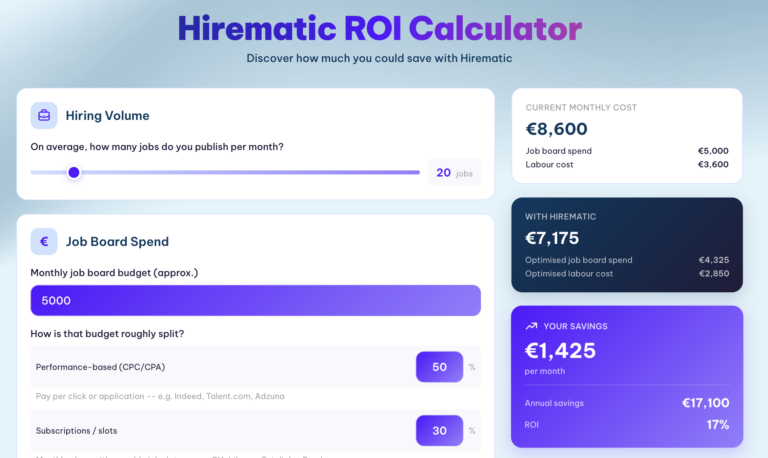
Estimate Your Recruitment Advertising Costs with Hirematic’s ROI Calculator
With so many variables involved in your recruitment advertising spend, it’s easy to get overwhelmed.
This is why we’ve built Hirematic’s recruitment ROI calculator – a tool that estimates your recruitment advertising costs while showing you how much you can save with an optimised setup.
The calculator uses the key cost drivers discussed above as inputs, namely:
- Your monthly job board spend
- How your budget is distributed across channels
- The number of job boards you use
- The time your team spends managing job ads
- Your internal labour costs
And then compares your current setup’s costs with a more effective approach using Hirematic.
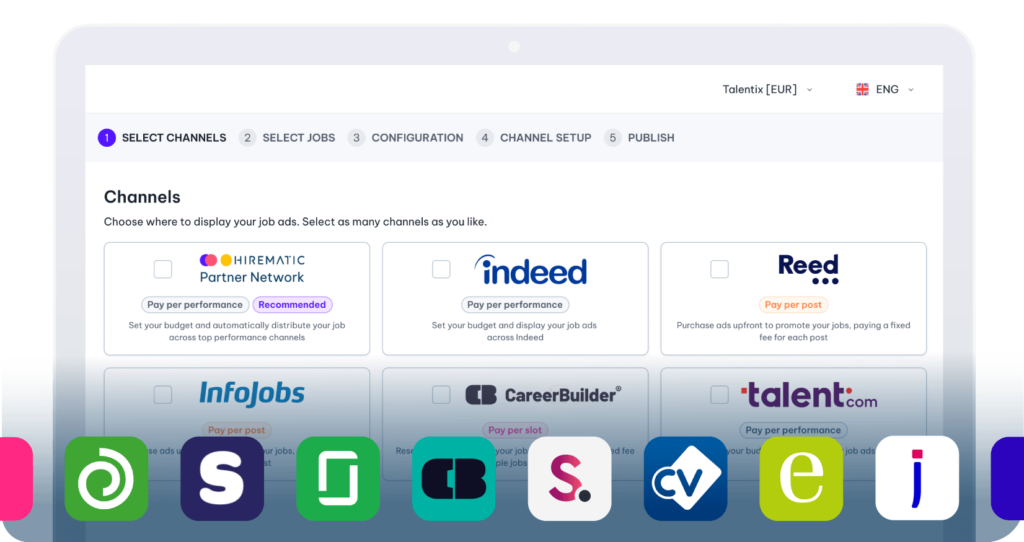
Hirematic is a recruitment marketing platform that replaces manual job board management with automated performance-driven optimisation. It distributes jobs across dozens of best-fit job channels, then continuously reallocates your recruitment advertising budget based on live data, helping hiring teams increase application volume and reduce CPA without upending their workflows.