


Some recruiters have been posting job ads manually for so long that it’s the only way they can imagine doing so. While manual job advertising isn’t inherently wrong – being perfectly effective in some cases – an overreliance on hands-on ad creation creates blind spots.
Recruiters may get too comfortable picking the same job boards and applying the same budget splits across published roles, even when hiring dynamics across industries and job types demand otherwise.
If you’re a recruitment manager wondering whether your job ads are working as hard as they could be, or looking for ways to make the most out of a tight recruitment budget, considering alternative approaches like programmatic job advertising can widen your perspective.
In this article, we’ll look at how manual and programmatic job advertising differ, and help you figure out which one is a better fit for you by covering:
What Is Traditional Manual Job Advertising?
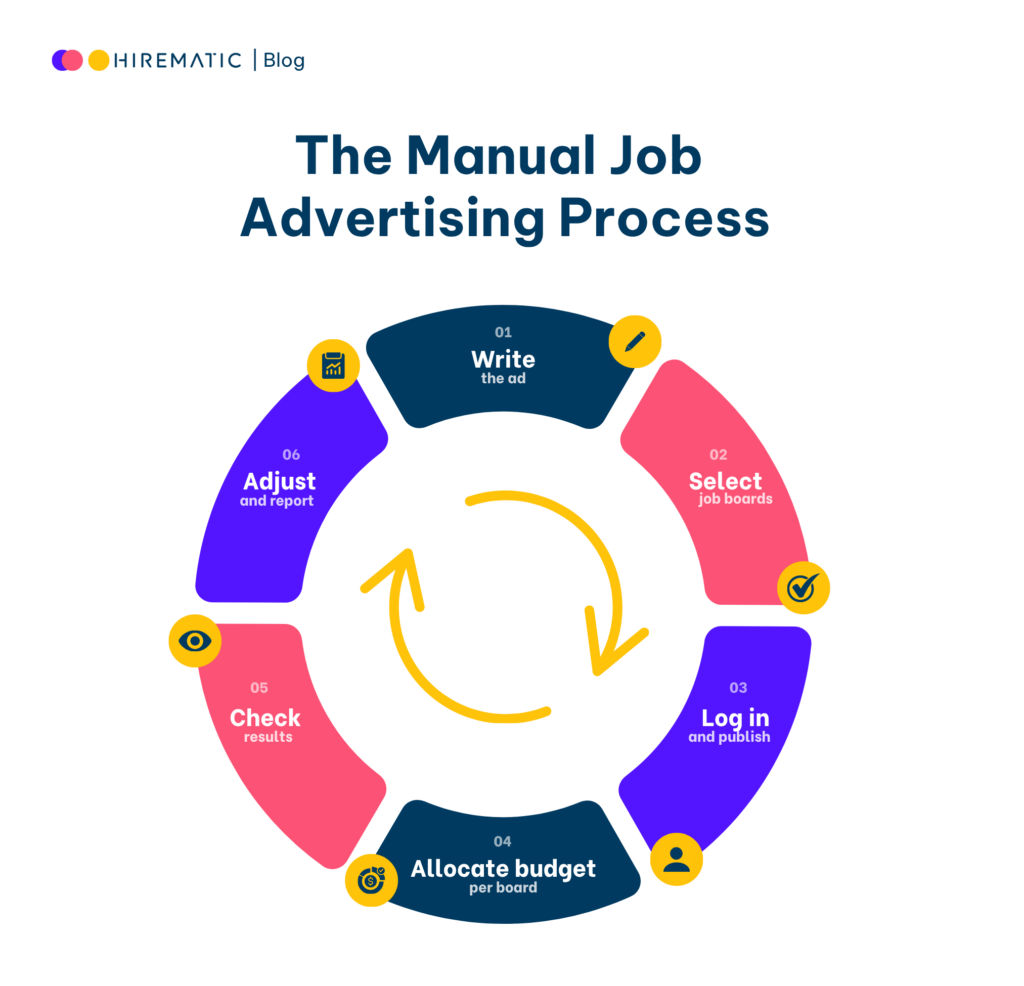
Manual job advertising is the hands-on, default approach to creating, publishing, and managing job ads across different channels and job boards. It typically involves a copy-paste process that has to be repeated across each chosen channel.
In practice, this means selecting job boards and channels individually – such as Indeed, LinkedIn, or industry-specific boards – writing and adapting copy to fit each platform’s requirements, and logging into each one separately to publish the adverts.
From there, recruiters allocate budgets to each board, check dashboards manually to track performance, and periodically pause, boost, or reallocate spend based on what they find. As part of this, they may create performance reports too, which involves manually consolidating reports pulled from each separate job dashboard.
Pros and Cons of Manual Job Advertising
Advantages | Disadvantages |
|---|---|
Full control over which channels your recruitment budget flows to | Time-consuming to manage across multiple boards |
Familiar and straightforward for small-scale and consistent hiring needs | Easy to default to the same boards – regardless of performance |
No recruitment marketing platform overhead or specific tooling costs | Hard to optimise promptly when results underperform |
| Doesn't scale well as hiring volume grow or role types expand |
Requires recruiters to double as campaign managers |
What Is Programmatic Job Advertising?
Programmatic job advertising – or programmatic recruitment advertising – uses algorithms, AI, and real-time bidding to automate job distribution across best-fit channels. Think right place, right time, right audience, with minimal manual oversight.
Programmatic job advertising is built on four key components:
- Budget allocation: You specify your campaign budget, which the platform then takes and distributes across the most suitable channels.
- Candidate targeting: AI algorithms – trained on thousands of historical data points from previous ads – determine which channels are most likely to reach the right candidates for each role.
- Live ad optimisation: Once ads are live, the programmatic solution makes real-time adjustments based on incoming performance data (i.e., redirecting spend to ads that deliver strong applications).
- Performance monitoring: A programmatic solution’s dashboard provides consolidated visibility into campaign performance across all channels – all from one place at once
This typically means faster, more cost-effective recruitment advertising that doesn’t require recruiters to double as campaign managers.

Pros and Cons of Programmatic Job Advertising
Advantages | Disadvantages |
|---|---|
Automates distribution and budget split across best-fit channels | May be overkill for small-scale or infrequent hiring |
Lets AI optimise spend in real time based on past and current performance | Less control over which specific boards or channels get spend |
Single, consolidated dashboard providing performance visibility across all channels | Requires initial setup and onboarding time |
Live optimisation which reduces cost per application at scale | Can feel like a black box if you don't understand how the algorithm is trained or works |
Frees recruiters from advertising admin | Upfront platform cost may not suit minimal budgets |
When Manual Job Advertising Is Enough
Manual job advertising makes the most sense when your hiring needs are straightforward and consistent, with minimal changes or fluctuations in demand.
That is:
- You're hiring a small number of roles at a time: If you're only filling one or two positions at a time, the overhead of a programmatic platform may not be worth it.
- Your roles are consistent and familiar: If you're regularly hiring for the same position in the same location, you’re likely familiar with the job boards that work, and manual posting is simple and manageable.
- You hire in a fixed geography: If you’re recruiting within one city or region, the breadth of reach provided by programmatic platforms might be overkill.
- Your budget is minimal: For teams with very limited advertising spend, manual posting allows granular control over every pound or euro spent.
- You're not under pressure to fill roles quickly: Since manual advertising takes longer to optimise, it’s best fit for situations where time-to-fill isn’t a priority.
When Programmatic Job Advertising Is the Better Fit
When complexity and scale become a factor, programmatic job advertising is worth considering. In practice, this can mean:
- You're managing multiple open roles simultaneously: Keeping track of performance across 10-50 active job ads manually is time-consuming and makes effective optimisation nearly impossible.
- Your have growing hiring needs: Manual processes become a bottleneck when high-volume hiring needs come up. Programmatic solutions can manage that without hands-on recruiter input at every step.
- You're hiring for roles that vary significantly: Different role types, seniority levels, industries, and locations each require different channels and audience strategies – which programmatic optimises for automatically based on data.
- Time-to-fill is a concern: If roles are high-priority and time-to-fill becomes a cost drain, programmatic can speed things up by automating distribution and targeting higher-quality candidates from the start.
- You want to reduce cost per application: Companies such as Ferrero Group have seen a 35% decrease in their CPA since using programmtic technology.
- Your team is overwhelmed or stretched thin: If your recruiters are struggling to stay on top of advertising admin, programmatic solutions can take on that burden.
In practice, things aren’t always so black and white, and you don’t need to completely rely on one over the others. Most tech-forward recruiting teams enjoy a healthy mix of both manual and programmatic job advertising as both have their own benefits and drawbacks.
Many teams run hybrid approach with programmatic solutions like Hirematic, which help with optimising spend on performance-based channels (like Indeed) while also allowing you to use up existing job board contracts or subscriptions through the same platform.
This hybrid approach works because Hirematic folds your existing job board contracts directly into the system setup so your existing credits don’t go to waste. This means you can start benefiting from real-time optimisation without waiting for contracts to expire or scrapping your hiring processes entirely.
Want to see how Hirematic works firsthand? Reach out to our team for a personalised demo!
