



Multiposters aren’t new. Having emerged in the early-mid 2000s as a distribution shortcut, they’ve been an easy way for recruiters to save time by posting jobs everywhere, all at once.
But just because they’ve stood the test of time, that doesn’t automatically make them the best solution for recruiters wanting to publish jobs across different channels. In some cases, multiposters become a hindrance, holding you back from achieving desired results – or outright draining your budget without you even realising. This is when a programmatic job advertising solution might be a better fit.
Whether you’re looking for alternatives to multiposters or are curious about making the step away from multiposters and toward programmatic recruiting platforms, this article will address the what, why, and when of taking that leap.
In this blog post, we’ll walk you through:
When Multiposters Work Well
If you’re tired of the manual process behind creating recruitment ads for each job board and social platform separately, and want a centralised solution to help you post your jobs all at once, multiposters like Broadbean or LogicMelon can be your go-to.
With a couple of clicks, you can advertise your job vacancies across a wide range of channels – all of which can be pushed and managed from a single dashboard. No need to go through the rinse and repeat process of creating an ad from scratch for each channel.
Multiposters are a great tool for your hiring team if:
- You only have a few open roles at any time
- You usually advertise roles that are similar (by job type, seniority, or salary band)
- You hire within a fixed, familiar geography – be that in one country or a few cities
- You rely on a static selection of job boards and don’t want to expand beyond them
- You’re not in a rush to fill roles
With these in mind, multiposters are typically better suited for smaller companies – start-ups or SMBs – with predictable hiring needs, limited geographic reach, and where optimising performance isn’t a priority.
Where Multiposters Start to Break Down
Yet, not all companies that are tired of manual job posting reap the same benefits from multiposters.
Multiposters aren’t the best solution for your business if:
- You’re managing a large number of live roles simultaneously
- You’re hiring for roles with very different seniority levels, skill requirements, and hiring behaviour
- You have high-priority roles that need to be filled faster than others
- You want to optimise the ROI of your recruitment efforts, not just distribute jobs
In these circumstances – where variety meets volume and more hands-on control is needed – the multiposters that once saved time can quickly turn into yet another layer of manual work that drains resources.
This is because:
- Performance visibility is split by job board
- Budget keeps flowing regardless of results
Performance Visibility is Split by Job Board
With more job ads come more responsibilities – more hands-on monitoring, more oversight. And while a multiposter takes the hassle out of posting job ads, it doesn’t make performance analysis any easier.
Performance data is siloed by job board, meaning recruiters wanting to check how each ad is doing would need to manually piece together insights from separate dashboards to get a holistic view of results and where adjustments are needed.
Budget Keeps Flowing Regardless of Results
Once you’ve pushed a job live using a multiposter, spend continues as per the initial set-up. There’s no automated system or built-in mechanism that reduces spend on poor-performing ads. Without recruiters stepping in to make changes, these inefficient budget leaks can quickly snowball into a lot of wasted budget – especially as hiring volume grows. Moving budget to the channels that convert is a core part of any high-volume recruitment strategy.
And even if recruiters are proactive and hands-on with data, by the time they’ve collected and consolidated data for each job ad across job boards, they’re likely behind real-time values. The data they’re using to inform their actions may already be outdated by the time it’s used.
So what recruiters may think is real-time optimisation is in fact damage control, making improving cost-per-applicant or cost-per-hire difficult.
What is Programmatic Job Advertising?
Programmatic job advertising – or programmatic recruitment advertising – is a smarter approach to managing your recruitment advertising budget.
Unlike multiposters, which post jobs to a fixed set of job boards using an even budget split, programmatic job advertising solutions keep track of where your money flows and ensure it’s spent efficiently. They automatically adjust the budget split based on results, reallocating funds from what doesn’t work to what does – no human input required.
When You Should Switch to Programmatic Job Advertising
If you’re unsure whether a switch to a programmatic recruitment advertising like Hirematic will lift a significant amount of stress off of your recruiting team’s shoulders, here are a few telltale signs that your current multiposter setup is starting to crack under pressure:
- You’re managing too many open roles at the same time and are struggling to see which ones need more budget or visibility right now
- Performance reviews feel reactive, with optimisations made after money is already spent or locked in
- Strong-performing roles aren’t filled faster, despite clear early signals that they could be
- Urgent, revenue-critical vacancies are treated the same as lower-priority roles
- Budget decisions are based on gut feelings or “we’ve always done it this way” because performance data is too difficult to act on
- Monitoring and reporting ad performance is eating up a lot of recruiters’ time
- Budget inefficiencies build up to significant costs and are impacting time-to-hire
- Recruiters are bogged down with monitoring ads instead of engaging with candidates or hiring managers
At Hirematic, we see these a lot in conversations with recruitment agencies, companies with high-volume hiring needs, and multinationals hiring across borders that use multiposters. In most cases, they’re no longer interested in just getting as many eyes on their job postings as possible by posting job ads everywhere.
They’re focused on efficient hiring, with money following results, not assumptions.
Recommended reading: 6 Reasons You (Absolutely) Need to Try Programmatic Job Advertising
What Changes With Programmatic Recruitment Advertising
If you’re ready to take the leap away from a multiposter and toward a programmatic recruitment advertising solution but are unsure what to expect, we’ll paint you a clear picture.
For starters, most programmatic solutions slot into your current recruitment marketing setup easily. Hirematic, for example, supports integrations with over 100 ATS and HR platforms, allowing you to benefit from programmatic capabilities without upending or disrupting existing workflows.
Once implemented, programmatic job advertising solutions such as Hirematic reduce the need for manual input right from the start.
Instead of launching campaigns that you then have to periodically revisit and update, Hirematic does this for you by keeping job ad optimisation continuous and automatic. It runs in the background as you go about your day-to-day – evaluating performance, adjusting ad placements, and shifting budget allocations all while sticking to the campaign rules you’ve set initially (e.g., shift budget away from roles that exceed target CPA thresholds.)
Programmatic tools also remove tedious reporting legwork. They consolidate job and campaign-level analytics into one dashboard, without you having to jump between dashboards and scavenge for scattered data. Hirematic takes it one step further by showing how candidates progress through the hiring funnel, making it easier to see where successful candidates come from.
Here’s an in-depth look at the differences between multiposters and Hirematic:
Multiposter | Hirematic | |
|---|---|---|
Primary responsibility | Distribute jobs without accountability for outcomes | Optimise job ad spend & channel allocation |
Performance scope | Slot-based channels | Performance, slot-based, & social channels |
Channel selection | Chosen manually | Automated & data-driven, adjustable by you |
Performance optimisation | After spending, manually | Real-time optimisation, while jobs are live |
Budget logic | Budget locked upfront even when channels underperform | Redistributed continously based on performance |
Contract management | Relies on separate job board agreements | One contract & invoice covering all job boards |
Spend flexibility | Fixed commitments per job channel | Flexible, performance-led spend |
Reporting | Per-channel | Centralised, full-funnel analytics across channels |
The Results Hiring Teams See
Hirematic customers who’ve relied on the platform’s programmatic capabilities have seen:
- Significantly higher application volumes
- Measurable ROI on hard-to-fill roles
- Reduced cost per application
A 67% Increase in Applicants
A mid-size UK staffing agency that had been struggling to attract enough applicants saw a 67% increase in monthly applicants after adopting Hirematic. By using the platform’s AI capabilities to optimise job ads and automate distribution based on performance signals, application volume grew from around 1,900 per month to more than 4,500 over the same period.
A 1,300% ROI on Hard-to-Fill Roles
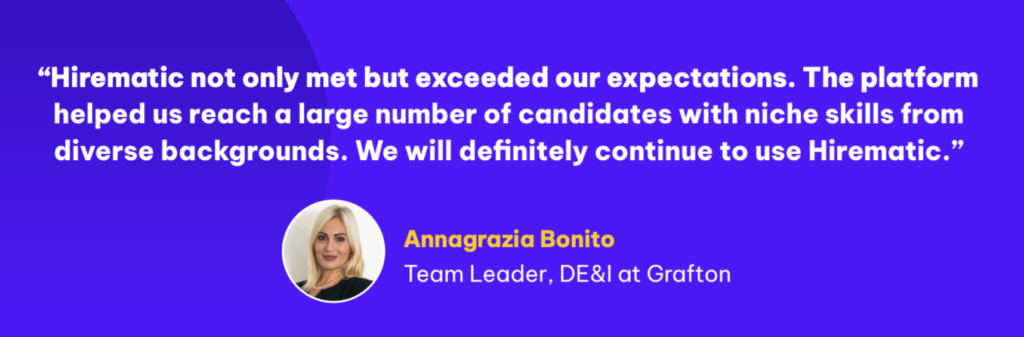
Grafton Recruitment focused on filling specialised, mid- to senior-level roles across the EU, which typically involve higher spend and longer hiring cycles. To minimise spend and time-to-fill, they ran 30 campaigns through Hirematic over 30 days. Hirematic’s ongoing, performance-based budget reallocation helped the agency achieve a 1,300% ROI while keeping cost per application low and attracting qualified candidates for niche positions.
A 50% Reduction in CPA
Mitsubishi Electric needed to hire skilled mechanical assembly workers in a highly competitive Italian labour market with tight budgets. By running a one-month programmatic campaign through Hirematic, the company generated 1,000 applications and reduced average cost per application by 50%, saving approximately €50,000 in recruitment marketing spend.
Ready to Give Programmatic Job Advertising a Try?
It automatically directs budget toward the roles and channels that perform best while keeping everyone in the loop with clear performance visibility. This helps recruiting teams focus on the human work that moves hiring forward – engaging candidates and aligning with hiring managers – helping drive impact across all fronts.
To see how a programmatic setup can work for your company, book a demo with Hirematic and see its applications right away.
